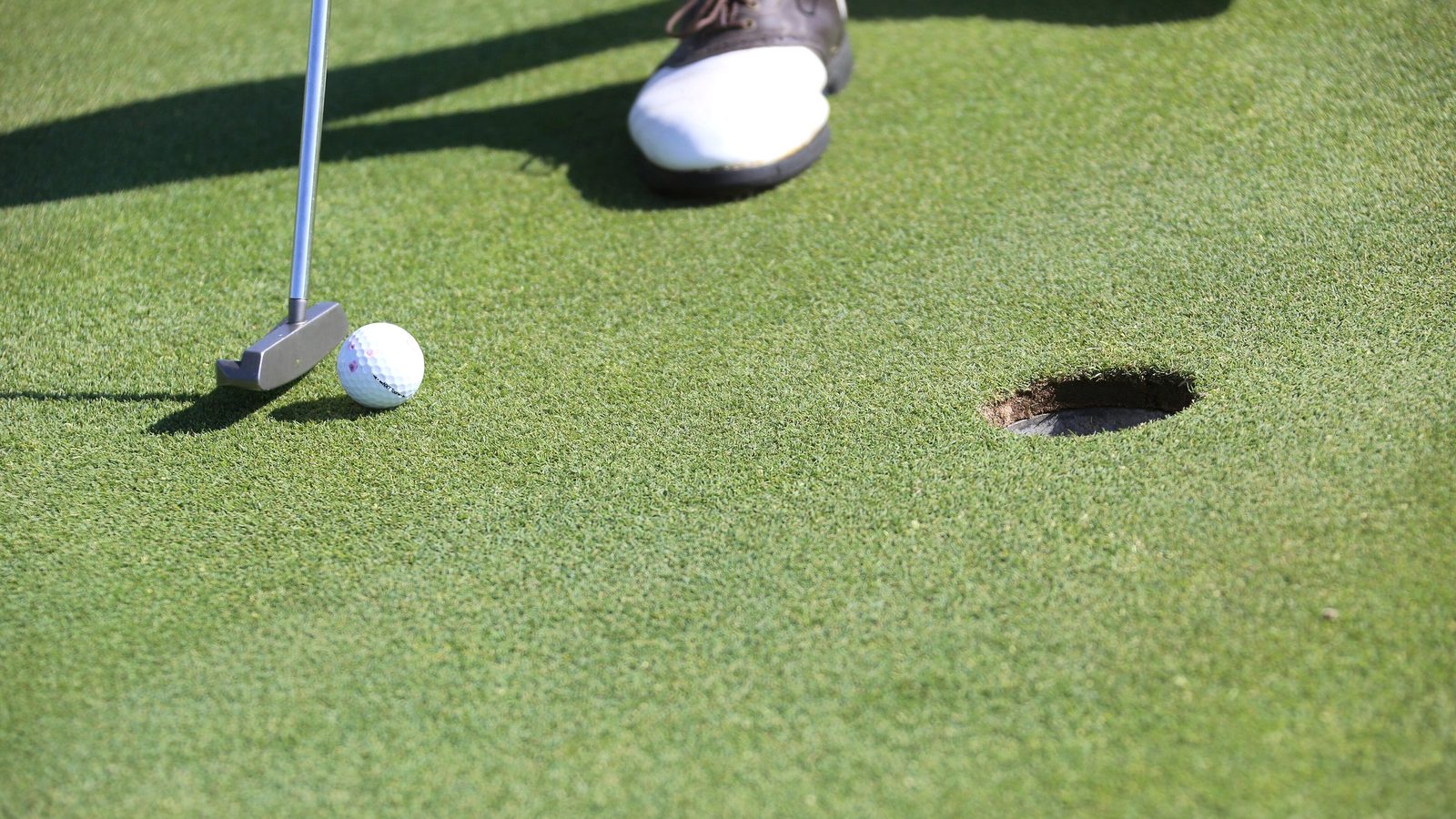
Go to any driving range on a Saturday morning and count the drivers. Then walk over to the practice green. It’s usually empty. That’s a strange way to prepare for a game where most of the shots happen on or near the green.
Where your shots actually go
Take a typical club golfer who shoots around 90. Over 18 holes, their card breaks down something like this:
- About 35 putts. That’s two a green, plus a few three-putts.
- Around 20 chips, pitches and bunker shots from inside 100 yards.
- 18 tee shots, 14 on par 4s and 5s and 4 on the par 3s.
- Around 17 other shots from beyond 100 yards: approaches, layups and recoveries.
Add the first two together and roughly 55 of the 90 shots, about 61%, are played within 100 yards of the hole.
That lines up closely with Dave Pelz, the short-game coach and former NASA physicist, who tracked thousands of rounds and found that 60 to 65% of shots are played within 100 yards, and that putting makes up around 40% of all strokes.

Where the practice actually goes
Now think about how most of us practise. A bucket of balls, a driver first, then the 7-iron, then back to the driver because it’s more fun. Maybe a few putts before the round, if there’s time.
It’s easy to see why. Hitting drivers feels like golf. Rolling 4-foot putts feels like homework. But it means most golfers spend most of their practice on the shots they play least often.
If six in ten of your shots are near the green, your practice should spend a lot more time there than it does.
The twist most golf tips leave out
So should you stop hitting drivers altogether? No, and this is the part that usually gets left out.
Mark Broadie, the Columbia University professor behind golf’s “strokes gained” statistics, looked at shot-by-shot data from amateurs and tour professionals. His finding, in Every Shot Counts (2014), was that about two-thirds of the scoring difference between golfers comes from shots outside 100 yards.
Both things are true at once:
- Most of your shots are near the green.
- Most of the shots you lose to a better player are further out: the tee shot in the trees, the approach that misses the green by 30 yards, the layup into a bunker.
Long shots are fewer, but each bad one costs more. A three-putt costs one shot. A drive out of bounds costs two, and often more.

So how should you practise?
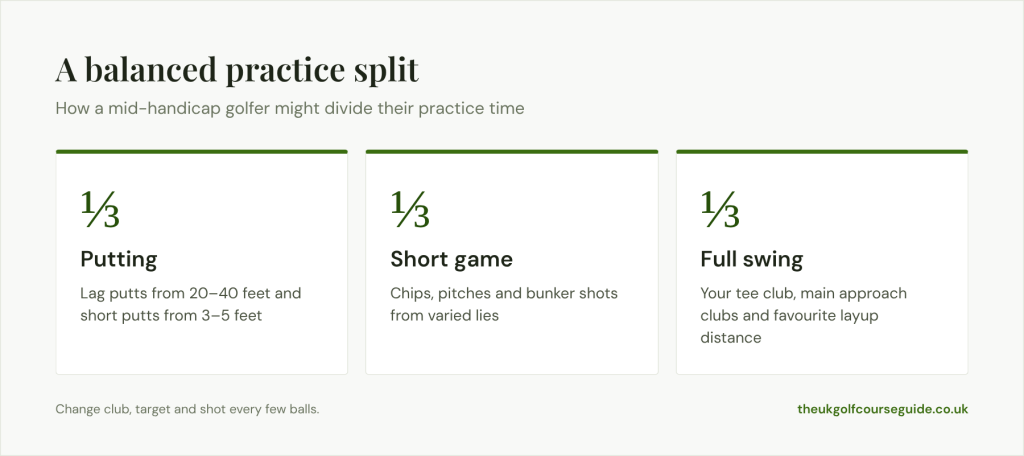
Practise in proportion, and with a purpose. A simple split that reflects both sides of the numbers:
- Around a third on putting, mostly lag putts from 20 to 40 feet and short putts from 3 to 5 feet. Those are where three-putts come from.
- Around a third on chipping, pitching and bunker play, from varied lies and distances.
- Around a third on full shots, but not just the driver. Your tee club, your most-used approach clubs, and the layup distance you like.
The key word is purpose. Fifty balls hit at the same target with the same club teach you very little. Change the club, the target and the shot every few balls, the way you would on the course.
A one-hour practice session
- 15 min lag putting, 20 to 40 feet
- 10 min short putts, 3 to 5 feet, holing out
- 20 min chipping and pitching, changing club and lie
- 15 min full shots: tee club, then approaches to different targets
If you only have 20 minutes
- 10 min putting: 5 lag putts, then 20 short ones
- 10 min chipping to one target with three different clubs
Twenty minutes on the putting green before a round will save more shots than twenty minutes hitting drivers.
Track it, and practise what costs you
The best practice plan is the one built on your own game. For your next five rounds, jot down after each hole:
- How many putts you took
- Whether you had a penalty shot
- Whether a chip or pitch stayed off the green
After five rounds you’ll know exactly where your shots are going. Most golfers who do this are surprised, and their practice changes overnight.
For a round-by-round plan, read how to break 90. And if the weather has closed the course, there’s plenty you can do indoors with our 5 ways to improve your golf over winter.
Sources
- Dave Pelz, Dave Pelz’s Short Game Bible (1999)
- Mark Broadie, Every Shot Counts (2014)
- The round of 90 breakdown is an illustrative estimate for a typical mid-handicap golfer, not survey data.