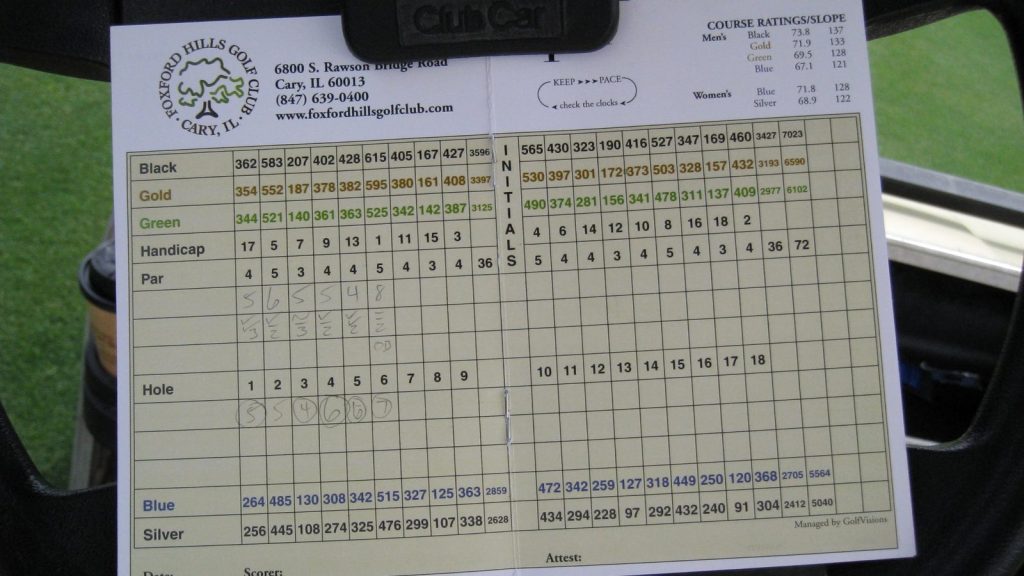
Breaking 90 is the milestone most club golfers chase, and it’s closer than it feels. On a par 72 course, a bogey on every hole is 90. Make one par, and bogey everything else, and you’ve done it. The secret isn’t more pars. It’s fewer doubles.
Do the maths before you tee off
Think of every hole as a par 5 with your name on it (a par 6 on the long holes if you get two shots there). If you’re a handicap of around 18, that’s literally what your shots are for.
That changes how you play:
- On a 420-yard par 4, you don’t need to reach the green in two. Two decent shots and a pitch, then two putts, is a bogey.
- On a par 3 with water in front, the middle of the green, or even short and dry, is a perfectly good result.
- A par is a bonus, not the target.
Golfers who shoot 95 to 100 usually make plenty of bogeys and the odd par. What costs them is three or four doubles and a triple. Cut those out and 89 arrives on its own.
You don't break 90 by making birdies. You break 90 by not making sevens.
Where the big numbers come from
Look back at your last few cards. The doubles and worse almost always come from one of four places:
- Penalty shots: out of bounds, water, or a lost ball, usually off the tee.
- Hazard escapes that don’t escape: two shots in a bunker, or a hack out of the rough that goes 10 yards.
- Duffed or thinned chips: the ball stays off the green, or races through it.
- Three-putts: usually from long range, when the first putt finishes 8 feet away.
Every one of those is fixable without changing your swing.
Off the tee: in play beats long
A drive of 200 yards in the fairway is worth more than 240 yards in the trees. If a hole has out of bounds or water in range of your driver, hit the club you can keep in play, whether that’s a 3-wood, a hybrid or a 5-iron.
Pick a target on the widest side of the fairway, away from the trouble, and commit to it. A miss into the light rough on the safe side still leaves a bogey, at worst.
Into the green: aim for the middle
The flag is not your target. The middle of the green is. Tour players miss greens; club golfers miss them more often, so make your misses count:
- If the pin is tucked behind a bunker, aim for the fat side of the green.
- If you can’t reach the green without a perfect shot, lay up to your favourite distance, say 80 yards, and pitch on from there.
- Take one more club than you think. Most amateurs come up short far more often than they go long.
Around the green
- Use the least lofted club that gets you over the fringe. Putter, then a 7 or 8-iron chip and run, then a wedge.
- Make the goal “on the green”, not “close to the hole”.
- From a bunker, just get out. Any part of the green will do.
On the green
- From long range, aim to finish inside a 3-foot circle around the hole.
- Speed first, line second. Most three-putts are caused by the wrong pace, not the wrong line.
- Hole out the short ones. Take your time with anything inside 4 feet.
Plan your practice around your scorecard
Most of your shots in a round of 90 are played within about 100 yards of the hole. Putting alone is around 35 to 40% of your strokes. Yet most of us spend our practice time hitting drivers at the range.
A simple weekly plan that suits breaking 90:
- Half your time on putting: lag putts from 30 to 50 feet, then lots of 3 to 4-footers.
- A quarter on chipping and pitching: get the ball on the green from different lies.
- A quarter on full shots: mostly your tee club and the clubs you use to lay up.
We go further into where your shots really go, and how to practise for it, in why your practice isn’t improving your golf scores.
On the day
- Write a target score for each hole on your card before you start: bogey on most, double on the one or two hardest.
- After a bad hole, reset. The maths only needs bogeys; one double doesn’t ruin anything.
- Don’t count until the 18th. Golfers who know they’re on for 89 with three to play have a habit of finding the trees.
Find somewhere new to try it with our UK golf course search. A course with a lower Slope rating is a kinder place to break 90 for the first time.